
ABOUT FRAGRANCE PERSPECTIVES
FRAGRANCE PERSPECTIVES examines the culture, power, and institutions
behind the world's oldest art form, and the questions the industry
has learned not to ask.
Fragrance is one of the world’s oldest art forms.
It deserves more than fragrance reviews.
Fragrance Perspectives is a global industry
publication by Serene B. Hollingsworth, published by Sanctuaire de Fleurs.
Reserve your Membership Below.
FRAGRANCE PERSPECTIVES 13, BY SERENE B. HOLLINGSWORTH
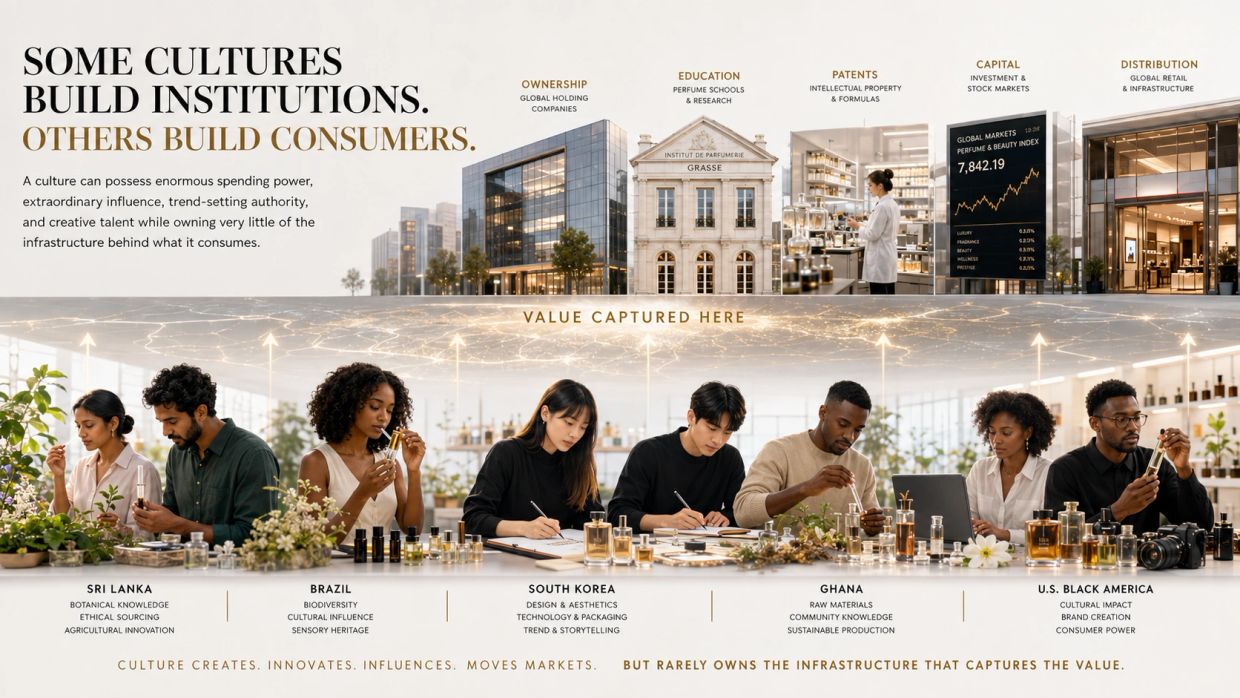
SOME CULTURES BUILD INSTITUTIONS. OTHERS BUILD CONSUMERS.
A culture can possess enormous spending power, extraordinary influence, trend-setting authority, and creative talent while owning very little of the infrastructure behind what it consumes.
FRAGRANCE PERSPECTIVES 13
Estimated Reading Time: 8 Minutes
Some ideas deserve more than a passing glance. I invite you to save this article and return when time allows for deeper reflection.
What happens when a culture possesses talent, influence, spending power, creativity, and desire, but has not yet built enough pathways for future generations to enter, learn, inherit, and expand the work?
This question stayed with me long after FRAGRANCE PERSPECTIVES 12 was published. The question was not whether Grasse deserved its authority. Grasse has already answered that question through generations of preservation, apprenticeship, cultivation, commerce, education, and institutional discipline.
If you have not yet read FRAGRANCE PERSPECTIVES 12, The Fragrance Industry Calls It Heritage. I Call It Power., I encourage you to begin there. This article continues that investigation. SANCTUAIREDEFLEURS.COM/FRAGRANCE-PERSPECTIVES
The more difficult question is how authority begins in the first place. Long before a region becomes synonymous with expertise, before a school becomes respected, before an archive becomes indispensable, and before a house becomes legendary, someone makes a decision. Someone decides that what exists today deserves a future tomorrow.
This is where cultural confidence enters the conversation.
I define cultural confidence as a culture's belief that what it has created possesses enough value to be documented, taught, protected, financed, expanded, criticized, improved, and ultimately passed forward.
Confidence becomes visible through preservation. It becomes visible through investment, succession, and the willingness to build institutions capable of carrying knowledge beyond the generation that first produced it. Cultures reveal what they value by what they choose to protect. They reveal what they believe by what they are willing to build.
Luxury founder Lisa Polite of LaPolie Fragrances offered another perspective:
"Cultural confidence is knowing where you come from so completely that you never have to perform it, prove it, or apologize for it."
Her observation points toward something important. Cultural confidence is not merely preservation. It is also certainty. Not certainty that others will approve, but certainty that approval is not required before building. As Polite later observed, "The confidence is the period. Not the argument." A culturally confident community, institution, or brand does not wait for validation before creating. It builds first and allows the work to speak for itself.
In this article, an institution is not merely a building, organization, or school. An institution is any structure capable of preserving knowledge, establishing standards, developing people, and transmitting what has been learned to future generations. A system is the collection of relationships, practices, resources, and processes that allow that institution to function, grow, and endure. One creates continuity. The other makes continuity possible.
When institutions and systems work together, knowledge becomes larger than any one individual. What begins as expertise becomes education. What begins as experience becomes inheritance. What begins as a founder's vision becomes something future generations can expand rather than rebuild from the beginning.
History often records institutions after they have become successful. It rarely records the uncertainty, risk, sacrifice, and conviction that preceded them. By the time a luxury house becomes legendary, a school becomes respected, a publication becomes authoritative, or an archive becomes indispensable, the struggle that accompanied its creation has largely disappeared from public memory. What remains is the institution itself, polished by time and often mistaken for inevitability.
We encounter permanence and mistake it for destiny. Yet nothing about institutions is inevitable. Every school, archive, publication, house, academy, and center of authority exists because someone decided it should exist. Someone determined that a body of knowledge deserved preservation. Someone believed future generations should inherit what had been learned.
That realization deepened my understanding of fragrance.
The deeper I explored the structures surrounding perfume, the more I realized that succeeding as a perfumer required understanding far more than composition itself. I found myself studying schools, archives, publications, founders, educators, trade organizations, and the systems through which knowledge survives. The perfumer remained important. The fragrance remained important. Increasingly, however, I became fascinated by the people building the conditions through which perfumery could exist long after they were gone.
The educator who establishes a school, the founder who creates a house, the writer who documents a culture, the archivist who preserves memory, and the institution builder who decides that knowledge deserves a future are participating in the same act. They are extending the lifespan of an idea. They are transforming individual achievement into collective inheritance. More importantly, they are building systems. Institutions do not simply preserve knowledge. They organize it. They transmit it. They make it accessible. They create standards, expectations, opportunities, and continuity. People can imitate success. Institutions make success repeatable.
Again and again, that investigation led me back to the same observation: a culture can possess enormous spending power, extraordinary influence, trend-setting authority, and creative talent while owning very little of the infrastructure responsible for preserving the value it creates.
A community may shape taste, move markets, define trends, influence aesthetics, and generate enormous economic activity while possessing relatively little of the infrastructure responsible for preserving the value it creates. It may excel at participation while struggling with preservation. It may produce extraordinary consumers while producing too few institutions.
The longer I sat with that observation, the more difficult it became to confine it to fragrance. The question was no longer simply about perfume. It was about ownership. It was about inheritance. It was about transmission. It was about what happens when talent exists in abundance, yet the systems responsible for developing, preserving, extending, and transmitting that talent remain scarce or do not exist at all.
The distinction became clearer through conversations with fragrance builders working outside traditional centers of authority.
One conversation that remained with me came from VILORIA, a fragrance house based in Sri Lanka. Although our circumstances differ, I was struck by how familiar many of the challenges sounded. Learning perfumery, according to VILORIA, remains difficult within Sri Lanka. Educational opportunities are limited. Regulatory requirements can be complex. Access to materials and licensing can present significant barriers. None of these realities diminish the desire to create. They simply make the journey longer, more expensive, and more difficult to navigate.
What fascinated me was not the difficulty itself. Every profession has barriers. What fascinated me was the larger question hidden beneath the response. How many future perfumers never enter the profession because the opportunity remains invisible? How many talented creators never discover fragrance as a possibility because no one opens the door? How does a young person in Chicago, Columbus, Accra, Rio de Janeiro, or Colombo discover a profession that is rarely discussed, rarely visible, and often protected by geography, access, and cost?
The fragrance industry spends considerable time discussing artistry, innovation, creativity, and vision. Far less attention is given to the structures that allow future perfumers to enter the profession in the first place. There are major fragrance houses creating educational opportunities and opening doors for students. The question is not whether opportunities exist. The question is visibility. How does a student know those opportunities exist? Who introduces them to the possibility? Who explains that perfumery is a profession?
This is what Grasse understood.
The power of Grasse was never fragrance alone. The power of Grasse was transmission. Not one school, but many. Not one generation, but many. Not one founder, but many. Knowledge moved from person to person, institution to institution, generation to generation until expertise became culture and culture became authority.
That is power.
The same principle appears elsewhere, though often at different stages of development. Korea's rise in beauty offers a different lesson. Its influence was not built through products alone. It emerged through the coordinated development of manufacturing, research, education, retail, branding, media, and cultural storytelling. Beauty became more than an industry. It became part of a national ecosystem capable of exporting identity, aspiration, and expertise alongside products. The result was not simply commercial success. It was cultural authority.
Brazil offers another compelling example. Fragrance in Brazil has increasingly become an expression of Brazilian identity rather than merely an imitation of European luxury traditions. Educational initiatives such as Paralela Escola Olfativa are helping localize fragrance education while supporting a distinctly Brazilian perspective on scent, culture, and creation. The goal is not simply to replicate Grasse. The goal is to build something of its own.
In Ghana, perfumer Yusif Meizongo Jnr represents another dimension of this work. Through Maison Yusif, he is contributing to the language, visibility, and authorship surrounding African perfumery. Long before institutions become established, someone must first demonstrate that a future is possible.
The examples differed. The pattern did not.
Confidence did not precede the work.
That conclusion appeared repeatedly throughout my conversations with founders and perfumers. Lisa Polite of LaPolie Fragrances described the relationship succinctly:
"Conviction is a bet. Confidence is evidence."
Her observation reinforces a pattern visible throughout this investigation. Builders rarely begin with certainty. They begin with conviction. Confidence is often the result of action rather than its prerequisite. It is earned through repetition, experimentation, mistakes, resilience, and accumulated proof.
The more I learn about fragrance, the more I understand how much remains to be learned. The more I study, experiment, fail, reformulate, purchase materials, speak with perfumers, and invest in education, the more respect I develop for the complexity of the profession. Confidence emerges through practice. It emerges through repetition. It emerges through accumulated knowledge. Most importantly, it emerges through conviction long before it emerges as certainty.
That distinction matters because builders rarely begin with confidence. They begin with belief. They begin with curiosity. They begin with a conviction that something worth preserving deserves to exist even when the infrastructure supporting it does not yet exist.
The same principle is beginning to appear across beauty and fragrance in the United States. Spelman College's Beauty Industry Essentials Program represents one example. BlackPerfumers.com and Legacy Scent Academy represent others. None of these initiatives possess centuries of history behind them. That is precisely the point. Institutions do not begin with heritage. They create it.
For generations, Black communities have demonstrated extraordinary influence across fashion, entertainment, beauty, language, culture, and consumer behavior. Entire industries have benefited from Black creativity and cultural leadership. Yet influence and ownership have never been synonymous. Influence and infrastructure have never been synonymous. Influence and institution-building have never been synonymous.
A culture can help define the market while owning very little of the machinery behind it. History complicates the argument.
The deeper I explored questions of institutions, ownership, transmission, and cultural confidence, the more I encountered evidence that Black America had already solved portions of this problem before.
Long before I began my work in fragrance, Black beauty was building educational systems, professional networks, manufacturers, training programs, licensing influence, entrepreneurial opportunities, and economic mobility at remarkable scale. To dismiss these accomplishments as merely beauty or trade is to misunderstand what was actually being built.
Luxury should not be understood merely as a category of products. Luxury is the ability to preserve expertise, establish standards, develop talent, transmit knowledge, and extend influence across generations. By that definition, many of the most important Black beauty pioneers were engaged in the same institutional work that has historically elevated other professions to positions of authority.
One of the most remarkable examples emerged through Marjorie Stewart Joyner (1896–1994). Working within the Madam C. J. Walker organization, Joyner helped oversee a network that eventually grew to approximately 200 beauty schools while training thousands of beauty professionals throughout the United States. The number is astonishing not because of the schools themselves, but because of what they represented: curriculum, standards, professional development, entrepreneurship, economic mobility, and succession.
Two hundred schools represent more than education. They represent infrastructure.
Chicago became one of the great centers of Black beauty development. Companies such as Johnson Products, Soft Sheen, and later Luster Products did far more than manufacture products. They invested in professional education, stylist development, training programs, trade events, educator networks, and the systems necessary to support an entire industry. They were not merely producing products. They were producing expertise.
Products create revenue. Institutions create continuity.
The beauty pioneers understood that authority required more than successful products. It required education, standards, training, ownership, and the ability to prepare future generations to expand the work.
The irony is difficult to ignore.
Today, states such as New York are requiring textured-hair education within cosmetology curricula after generations of students graduated without adequate preparation to work with textured hair. Yet Black beauty institutions had been teaching this knowledge decades earlier. What once existed within Black-owned educational systems increasingly required legislative intervention to re-enter mainstream instruction.
Institutions do not merely preserve knowledge. They determine whether knowledge survives.
That observation is not new.
Tom Burrell explored a version of this tension decades ago in Brainwashed: Challenging the Myth of Black Inferiority. In Chapter 7, "Buy Now. Pay Later," Burrell examined questions of consumption, ownership, advertising, and economic participation that remain remarkably relevant today. The age of the book is important because it reminds us that these questions did not suddenly emerge. Communities do not accidentally become consumers. Consumer identities are cultivated over time, often without the explicit knowledge or permission of the communities themselves.
Who produces? Who owns? Who benefits? Who is taught to build? Who is taught primarily to consume?
Those questions extend far beyond fragrance. They help explain why a community can possess enormous influence while controlling relatively little of the infrastructure surrounding the industries it helps sustain.
Someone had to be defined as the consumer.
Markets cultivate consumers. Institutions cultivate producers. Cultures with strong institutional traditions often cultivate both.
History suggests that communities rarely become consumers by accident. Consumption is reinforced through systems just as ownership, authorship, and expertise are reinforced through systems. Communities become builders when institutions create environments where knowledge is transmitted, expertise is respected, and future generations can enter a profession without beginning entirely from zero.
That observation became increasingly difficult to ignore as I continued researching fragrance, beauty, entrepreneurship, and cultural confidence. The deeper I looked, the more I encountered founders building despite limited institutional support rather than because of it.
Many contemporary fragrance founders are not simply creating fragrance. They are simultaneously serving as perfumer, educator, marketer, photographer, content creator, customer service department, public relations team, and business owner. In many cases, they are also employees elsewhere. The work of building often occurs after work, before work, on weekends, and during the hours normally reserved for rest.
Talent is not the scarce resource. Creativity is not the scarce resource. Curiosity is not the scarce resource. The more interesting challenge is that many builders are attempting to create institutions while simultaneously trying to sustain themselves.
Building anything of significance requires resources. Materials cost money. Education costs money. Conferences cost money. Travel costs money. Mistakes cost money. Most expensive of all is time. For independent perfumers, the cost of entry extends far beyond a bottle on a shelf. The investment often includes years of study, experimentation, failed formulations, discarded ideas, raw materials, books, evaluations, mentoring relationships, and continuous learning. Much of that investment occurs long before meaningful revenue appears.
The result is a curious paradox. Many independent perfumers still require employment to support the very work they hope will eventually become sustainable. Yet the process of building often changes the builder.
A perfumer builds expertise through entrepreneurship and then discovers that entrepreneurship itself may be viewed as a liability in certain professional settings.
Corporate America frequently speaks the language of innovation, entrepreneurial thinking, curiosity, and problem-solving. Yet entrepreneurship itself can create tension. The founder has learned to make decisions. The founder has learned to trust judgment developed through experience. The founder has learned to identify inefficiencies, question assumptions, solve problems without permission, and place value on expertise, including their own.
Corporate America often wants entrepreneurial energy without entrepreneurial authority. It values initiative, creativity, curiosity, and innovation, but may become less comfortable with the individual who has already built something, developed a point of view, acquired independence, and learned to operate without waiting for permission.
Pink Mahogany founder Chavalia Dunlap captured a version of this challenge when discussing employment within fragrance:
"One current challenge that perfumers have is running into a block when desiring to work for a fragrance house. More often than not, when a perfumer owns their own fragrance house, the employer looks at that as direct competition instead of being open to exploring how the obtained knowledge would directly benefit them."
The observation stayed with me because it reveals a contradiction. The very experience capable of strengthening an organization can become the reason someone is viewed as a risk.
This reality is rarely discussed when conversations turn toward luxury. Luxury often celebrates the finished product. Far less attention is given to the conditions required to create it.
The more time I spend in fragrance, the more convinced I become that the future of the profession depends upon builders. Not simply perfumers, but builders willing to create archives, educational programs, publications, mentorship structures, communities, and systems capable of extending knowledge beyond themselves.
This is one reason I continue returning to a question that has followed me throughout this investigation.
Why is the United States one of the world's largest fragrance markets, yet rarely discussed as a center of fragrance authority?
The United States consumes fragrance, manufactures fragrance, markets fragrance, and influences fragrance at enormous scale. Yet discussions of fragrance authority almost immediately shift elsewhere. That distinction is fascinating because it suggests a difference between market power and cultural authority. One measures economic activity. The other reflects the ability to educate, preserve, document, and transmit expertise across generations.
What makes this question even more interesting is the growing number of independent American fragrance houses now emerging throughout the country. Together they represent a growing community of builders contributing new perspectives, new audiences, new stories, and new approaches to fragrance creation.
Yet one fact remains surprisingly difficult to establish.
No one appears able to say with certainty how many Black perfumers exist in the United States. Or globally. That absence is revealing because institutions count what they believe matters.
Industries track sales, launches, growth projections, and consumer behavior. But who is tracking the builders? Who is documenting the educators? Who is preserving the stories? Who is measuring the emergence of authorship itself?
Those questions matter because documentation is one of the earliest responsibilities of institutional development.
Knowledge that is not documented becomes difficult to preserve. Knowledge that is not preserved becomes difficult to transmit. Knowledge that is not transmitted often disappears.
Which brings me back to SANCTUAIRE DE FLEURS, A Maison.
My work has always been rooted in heritage, legacy, authorship, and the question of what survives. Fragrance was never separate from those questions. It was the doorway through which I entered them. The deeper I moved into perfumery, the more I found myself returning to the same set of concerns. Who teaches? Who documents? Who preserves? Who prepares successors? Who decides what is remembered? Who decides what disappears?
Those questions eventually became as important to me as composition itself because they determine whether knowledge remains individual or becomes institutional.
Every generation inherits knowledge it did not create. The question is whether it will preserve that knowledge, expand it, or allow it to disappear.
A culture reveals its confidence not merely through what it creates, but through what it teaches, preserves, documents, funds, and prepares others to inherit.
That may be the most important lesson hidden within fragrance.
This article is part of an ongoing investigation into authority, heritage, institution-building, authorship, and the future of fragrance.
Special thanks to VILORIA (Sri Lanka), LaPolie Fragrances (United States), and Pink Mahogany (United States) for contributing perspectives that informed this investigation into cultural confidence, institution-building, authorship, and the future of fragrance.
FRAGRANCE PERSPECTIVES continues to explore the questions shaping not only perfumery, but the systems that determine who is remembered, who is taught, who inherits, and who ultimately defines luxury.
I invite you to explore the complete FRAGRANCE PERSPECTIVES series and discover the work of SANCTUAIRE DE FLEURS, A Maison.
With reverence,
Serene B. Hollingsworth
Parfumeuse de Vérité | Composer of Extrait de Parfum
Founder, SANCTUAIRE DE FLEURS
Experience the Maison:
SANCTUAIREDEFLEURS.COM
Media Inquiries:
https://sanctuairedefleurs.com/media-inquiries

FRAGRANCE PERSPECTIVES 12, BY SERENE B. HOLLINGSWORTH
The Fragrance Industry Calls It Heritage. I Call It Power.
Grasse, South Africa, Brazil, Dubai, and Korea reveal a truth the fragrance industry rarely discusses openly: the greatest luxury houses were not built on fragrance. They were built on authority, the ability to shape standards, preserve knowledge, build institutions, and create the kind of influence that eventually becomes heritage and legacy.
The fragrance industry speaks constantly about heritage, yet it speaks far less about the mechanisms that create it. That omission matters because heritage is often presented as though it were inherited rather than constructed, as though it emerged naturally rather than through deliberate effort. In reality, every authority, every institution, every archive, every luxury house, and every fragrance capital began with a series of decisions. Someone decided the knowledge mattered. Someone decided it deserved investment. Someone decided it should survive.
The question, then, is not whether heritage exists. The more important questions are who gets to create it, who gets to sustain it, and who gets remembered when it does.
The recent 60 Minutes feature on Grasse reminded viewers why the French town remains one of the most respected names in fragrance. Audiences were introduced to flowers, growers, artisans, and generations of perfume tradition. Most people saw a story about perfume. I saw a story about power. Not power in the conventional sense of wealth or prestige, but institutional power: the power to preserve knowledge, establish standards, define excellence, and ultimately determine what becomes heritage and what disappears from memory.
That distinction matters because Grasse did not become Grasse simply because flowers happened to grow there. Extraordinary flowers grow in many places throughout the world. Grasse became Grasse because generations of people decided fragrance knowledge was worth protecting. They built schools, businesses, supply chains, archives, relationships, expertise, and eventually institutions capable of carrying that knowledge beyond individual lifetimes. What the industry calls heritage is often the visible result of authority accumulated over time.
That is why UNESCO's recognition of the perfume related skills of the Pays de Grasse is so significant. The designation did not merely recognize flowers. It recognized cultivation, the transformation of raw materials, and the art of perfume composition. In other words, it recognized an entire system of knowledge and transmission. The world was not simply honoring a harvest. It was honoring an institution.
That may be the most important lesson Grasse offers the fragrance industry. The greatest luxury houses were not built on fragrance alone. They were built on authority.
Authority attracts investment because investors trust systems that endure. Authority attracts talent because ambitious people seek places where excellence is recognized and cultivated. Authority attracts education because knowledge naturally gathers around established centers of expertise. Over time, authority creates archives, critics, standards, institutions, and eventually heritage. Once authority becomes heritage, however, it begins to look inevitable. History has a way of disguising construction as destiny.
But Grasse was not inevitable. Grasse was built.
That realization changes the conversation because it forces us to ask a different question. If fragrance authority were created by natural abundance alone, the geography of perfumery would look entirely different. South Africa, for example, would almost certainly occupy a far more central place in the industry's imagination.
The Cape Floral Region contains approximately 9,000 plant species, with nearly seventy percent found nowhere else on Earth. It is one of the most botanically significant regions in the world. Yet when fragrance authority is discussed, South Africa rarely occupies the center of the conversation. The issue is not whether South Africa possesses significance. It unquestionably does. The issue is why extraordinary natural wealth has not translated into equivalent fragrance authority.
That question is not botanical. It is institutional.
Natural wealth creates possibility, but possibility alone does not create authority. Authority requires preservation, education, investment, interpretation, distribution, criticism, and collective belief. South Africa illustrates the limits of abundance when abundance is not converted into enduring institutions capable of preserving and amplifying cultural value across generations.
Brazil reveals something equally important. Too often, Brazil is discussed merely as a large fragrance market. That framing understates what has actually occurred. Brazil did not build influential fragrance houses by waiting for validation from Europe. It built domestic houses, distribution networks, and consumer trust. Most importantly, it built a culture in which locally authored fragrance could be viewed as legitimate rather than secondary.
That distinction is profound because a house becomes a house when people believe it deserves to exist. Cultural confidence is not a marketing slogan. It is infrastructure.
Brazil demonstrates that fragrance authority can emerge when a culture supports its own authorship long enough for institutions to form around it. The result is not merely consumption. The result is continuity, the ability to sustain creative identity across time rather than relying exclusively on external validation.
Dubai offers another model entirely. It did not inherit Grasse's mythology, nor did it need to imitate France in order to become influential. Instead, Dubai built from its own foundations: ritual, oud, hospitality, commerce, tourism, architecture, and an unapologetic belief in its own luxury language. It did not ask permission to participate in luxury. It expanded the definition of luxury through its own point of view and, in doing so, demonstrated that authority can be created through cultural conviction as much as historical inheritance.
Korea may be doing something similar. Within a generation, Korean beauty moved from the margins of global beauty culture to its center. It reshaped retail, product development, consumer expectations, and international beauty conversations. Korean fragrance appears to be entering that same current of cultural confidence and influence, building not only products but also the ecosystem necessary to support long-term relevance.
Grasse, South Africa, Brazil, Dubai, and Korea are not the same story, nor should they be. Each represents a different relationship between culture, resources, identity, and influence. Yet together they reveal a truth the fragrance industry rarely states plainly: authority is not fixed. It is built. Authority becomes institution. Institution becomes heritage. Heritage becomes legacy.
This is why Grasse matters to this series. Not because it should be worshiped, and not because it should be replicated. It matters because it exposes the machinery beneath authority itself. More importantly, it exposes a question that extends far beyond fragrance: Why do some cultures successfully convert knowledge into authority, authority into institutions, and institutions into heritage, while others spend generations standing outside the doors of those same institutions studying them from a distance?
That question sits beneath every conversation about luxury, legitimacy, influence, and legacy. It also sits beneath every conversation about fragrance. Who decides what endures? Not what sells, not what trends, and not what wins awards, but what endures.
Every archive is an answer to that question. Every institution is an answer to that question. Every house is an answer to that question. Every fragrance culture is answering that question whether it realizes it or not.
The conversation becomes even more complex when we begin asking who has historically had access to build institutions, who has had access to capital, who has had access to preservation, and whose stories have been deemed worthy of continuation. Those questions extend far beyond fragrance. They extend into culture itself, into the systems that determine whose contributions are remembered and whose disappear from view.
The fragrance industry is comfortable discussing heritage, but it is far less comfortable discussing access to the mechanisms that create it. That discomfort is worth examining, and it is where this series begins. Because before authority becomes heritage, a culture must first believe its own work deserves preservation.
That conversation continues in FRAGRANCE PERSPECTIVES 13: What Creates Cultural Confidence?
Editor's Note: This article is Part I of a seven-part FRAGRANCE PERSPECTIVES series exploring fragrance authority, cultural confidence, luxury authorship, institution building, invisible labor, succession, and legacy.
With reverence,
Serene B. Hollingsworth
Parfumeuse de Vérité | Composer of Extrait de Parfum
Founder, SANCTUAIRE DE FLEURS
Experience the Maison:
SANCTUAIREDEFLEURS.COM
Media Inquiries:
https://sanctuairedefleurs.com/media-inquiries
FRAGRANCE PERSPECTIVES 11, BY SERENE B. HOLLINGSWORTH
The Church Still Understands Fragrance Better Than the Industry.
6 minute read.
This one deserves your full attention.
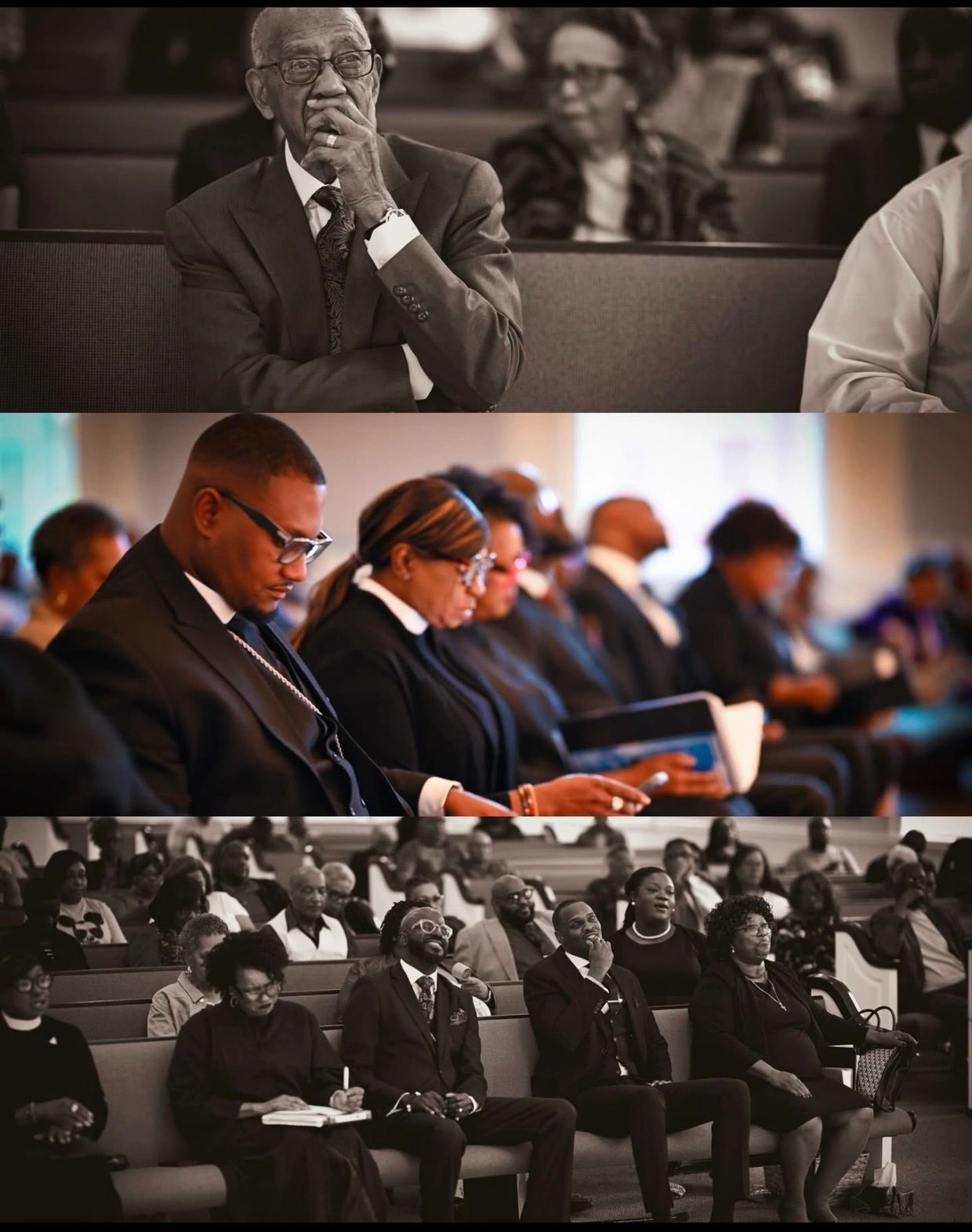
The fragrance industry may have more to learn from the church than it wants to admit. In sacred spaces, fragrance is not reduced to personal admiration or the shallow reward of being noticed. It serves a higher purpose. It prepares the atmosphere in reverence for worship, grief, hope, memory, healing, and the holy work of gathering before God.
That distinction stayed with me while SANCTUAIRE DE FLEURS composed the signature scent for Shaw Temple A.M.E. Zion Church in Smyrna, Georgia, the largest A.M.E. Zion congregation in the state.
Shaw Temple belongs to a denomination whose history reaches the Underground Railroad, abolition, Harriet Tubman, Frederick Douglass, Sojourner Truth, and generations of Black spiritual resistance and leadership in America. To compose fragrance for a congregation carrying that lineage required understanding immediately that this assignment could not collapse into ambience or aesthetic styling. The work demanded reverence.
That distinction matters deeply to the Maison. SANCTUAIRE DE FLEURS has always been composed through the stories, legacy, and lived experience of Black women. The Maison was never conceived merely as a place for fragrance consumption. It was conceived as sanctuary. A space where memory, grief, beauty, tenderness, spirituality, survival, and cultural inheritance could exist together without reduction. Black life carries all of those truths simultaneously, and fragrance, at its highest level, can hold emotional and spiritual weight language alone sometimes cannot contain.
That understanding shaped the work inside Shaw Temple.
Originally, I believed another fragrance composition I had already created would become the scent of the sanctuary. It was a beautiful fragrance. Sophisticated. Completely wrong for the room.
Once installed inside the church, I understood immediately that the composition performed too loudly within the emotional architecture of worship. It behaved like fragrance composed to be admired rather than fragrance composed to support what was happening spiritually inside the sanctuary itself.
So I began again.
The fragrance ultimately released into Shaw Temple on Mother’s Day was named CHOSEN. Built with cedar, bergamot, sweet orange, lilies, and softened rose, the composition was designed to welcome the congregation into the sanctuary gently rather than announce itself loudly.
Cedar grounded the fragrance with warmth, steadiness, and spiritual weight. Bergamot introduced clarity and light. Sweet orange softened the emotional atmosphere and brought warmth into the sanctuary. Lilies carried reverence and quiet elegance. Rose, used delicately, brought tenderness, care, and softness into the room without demanding attention.
None of those decisions were ornamental.
Interior fragrance composition requires an entirely different discipline from fragrance composed for the body. It cannot dominate the room. It cannot compete with prayer, music, memory, grief, celebration, or the emotional vulnerability that enters a church each Sunday. The fragrance must know its place. It must support rather than interrupt. It must move quietly enough to allow people to feel something before consciously recognizing why they feel it.
That subtlety fascinated me.
People do not always immediately notice interior fragrance consciously. Sometimes one person quietly mentions the atmosphere before others begin recognizing what they are already experiencing emotionally. Remove the fragrance, however, and the absence becomes unmistakable. The room changes. The emotional condition changes. The architecture of the experience changes.
That is the power of atmosphere.
I have now completed two fragrance installations, both within churches. That does not feel accidental to me. SANCTUAIRE DE FLEURS began as a sanctuary long before it became a Maison, which perhaps explains why the work feels most aligned in spaces carrying faith, collective memory, grief, hope, healing, worship, and reverence.
The assignment in those spaces is not spectacle. It is atmosphere. It is emotional architecture. It is preparation for what humanity is about to carry together inside this sacred space.
And perhaps that is what the church still understands more deeply than the fragrance industry. Fragrance was never only meant to attract attention. At its highest form, fragrance has the power to consecrate atmosphere itself.
With reverence,
Serene B. Hollingsworth
Parfumeuse de Vérité | Composer of Extrait de Parfum
Founder, SANCTUAIRE DE FLEURS
Experience the Maison:
SANCTUAIREDEFLEURS.COM
Media Inquiries:
https://sanctuairedefleurs.com/media-inquiries

FRAGRANCE PERSPECTIVES 10, BY SERENE b. hollingsworth
Three Black Women. One Language. No Translation.
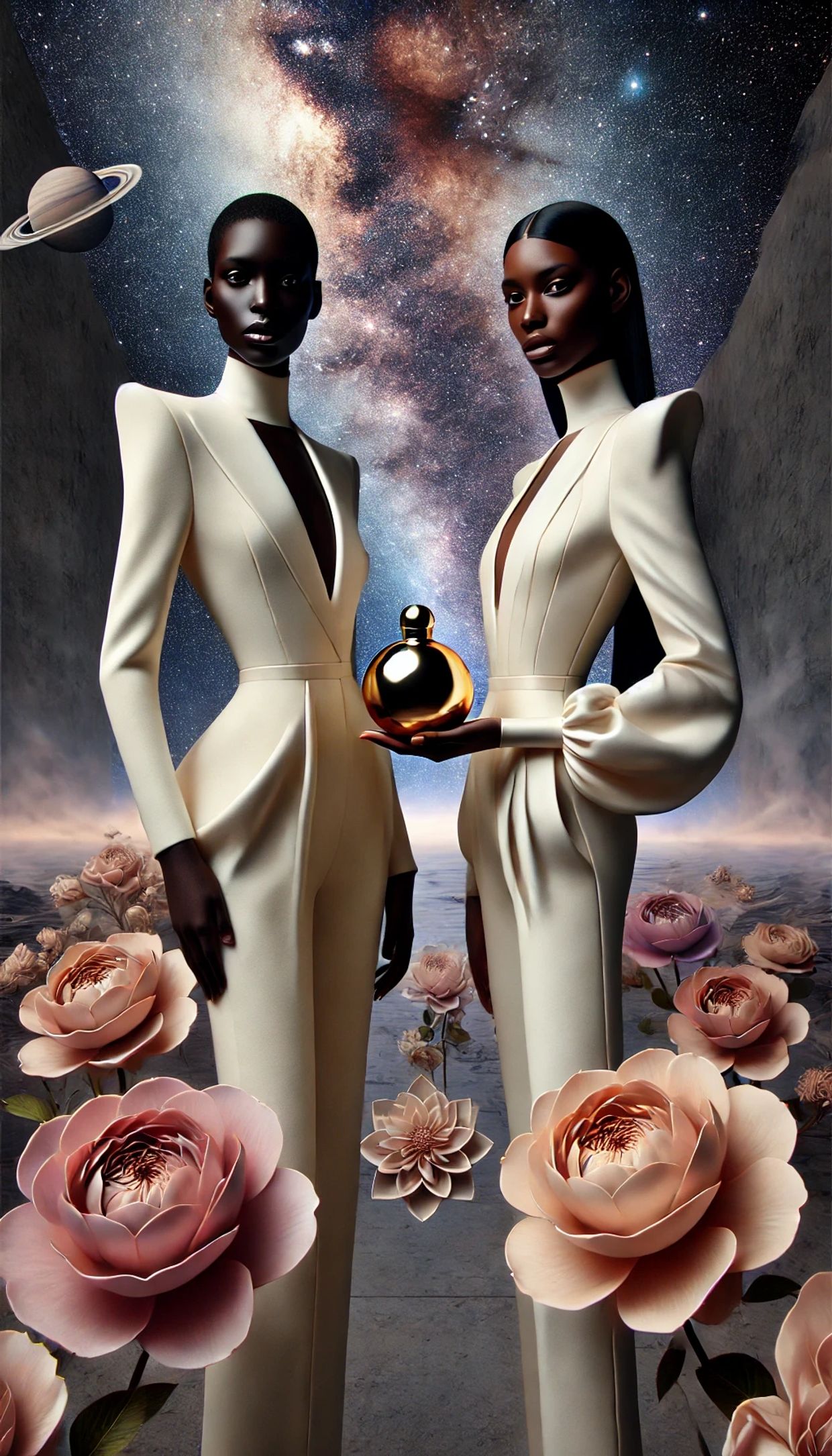
This work did not require a famous face to become believable. It did not reach for recognition to justify its presence. It did not borrow authority from outside itself. What you are seeing is the result of alignment. A Black model, Sophia Felder. A Black photographer. A Black Parfumeuse de Vérité. Each bringing her full authorship to the work. Nothing here is translated. Nothing here is adjusted for acceptance. The image, the fragrance, and the intention speak the same language because they were created within it.
Luxury is too often performed as spectacle.
It arrives dressed in excess, in borrowed status, in faces the market has already decided are safe enough to trust. It asks for approval before it asks for meaning. It leans on celebrity before it leans on substance. In doing so, it often mistakes visibility for depth.
This visual campaign for I LOVE MY LOCS reminded me of something far more powerful. Luxury does not need celebrity to become real. It does not need noise to become believable. It does not need to overstate itself to carry authority.
Sometimes luxury is a natural Black woman in full ease with herself. Sometimes it is softness that does not apologize for its strength. Sometimes it is a bottle held with the kind of familiarity that says, without effort, this belongs here.
These images are very different from the Black luxury futurism I have built into the wider visual world of SANCTUAIRE DE FLEURS. But they do not stand apart from the Maison. They deepen it. They reveal another truth within it. Skin, light, restraint, presence, tenderness, and confidence can carry just as much authority as the grander visual languages of the House. Perhaps more. Because there is nowhere to hide in simplicity. Only truth remains.
That is what makes this campaign meaningful to me.
It was not built through borrowed relevance. It was shaped through the alignment of Black women bringing distinct gifts to the same act of creation. Ashley Thigpen, through photography. Dr. Janan Graham-Russell, through anthropological insight and creative direction. And me, through the fragrance itself and the House it belongs to. This was not collaboration for appearance. It was collaboration in service of the work.
Too often Black women are invited into luxury only after the terms have already been written. Our beauty is welcomed, but not our authority. Our image is desired, but not our interiority. Our cultural power is referenced, but not trusted to define the work from within. What made this campaign feel different is that nothing here was ornamental. The woman, the fragrance, the image, and the intention belonged to the same language.
That is not small.
I LOVE MY LOCS is the founding fragrance of SANCTUAIRE DE FLEURS. Like all of my fragrances, it is Extrait de Parfum. It carries becoming, freedom, and power. It is bold by intention. It speaks with presence. In these images, I saw that truth again, but through another register, quieter, more intimate, and more grounded in the authority of a Black woman who does not need to perform luxury because she is already standing inside it.
This is part of what I am learning as I build the Maison.
Luxury can be expansive and visionary, but it can also stay close to the skin. It can live in futurism, archive, memory, and art. It can also live in the unforced elegance of a woman holding the work as though it has always belonged to her. All of it is real. All of it belongs to the House.
Luxury does not become real when the world approves it. It becomes real when the House knows what it is.
Smell the work. Experience the Maison. Choose the fragrance that belongs to your becoming.
With reverence,
Serene B. Hollingsworth
Parfumeuse de Vérité | Composer of Extrait de Parfum
Founder, SANCTUAIRE DE FLEURS
SANCTUAIREDEFLEURS.COM

FRAGRANCE PERSPECTIVES 09, by SereneB. HOLLINGSWORTH
Luxury taught the eye to admire the bottle first. Perfumery still has to answer for the juice.
For too long, the fragrance bottle has been allowed to perform luxury before the fragrance itself is ever fully met. It can arrest the eye, stir memory, and create longing on sight alone, which is precisely why the International Perfume Bottles Auction on May 2, 2026 deserves attention. It reminds us that the vessel has never been incidental. It has always been part of the theater, the memory, and the art.
I am looking forward to what this auction reveals because it affirms something many of us have understood for a very long time. A bottle can absolutely be art. It can evoke memory before the first spray ever touches skin. It can live on a tray, on a dresser, or in the imagination long after the fragrance has gone. The object itself can hold longing. It can hold beauty. It can hold a chapter of a life.
That understanding is not abstract for me. My grandfather, Charles Hollingsworth, worked for a glass house in the 1950s in Columbus, Ohio. I have long carried an appreciation for glass, for its beauty, for its shape, for the way it can appear delicate and enduring at once. Perhaps that is part of why I have never been able to see the perfume bottle as an afterthought. Glass remembers light. It also remembers touch.
Collectors have understood this for years, even in everyday ways. I have read reflections from fragrance lovers wondering what to do with an empty bottle of Baccarat Rouge 540 once the fragrance is gone, not because the bottle itself is so remarkable, but because the experience it held does not feel easily discarded. Sometimes it is memory. Sometimes it is feeling. Sometimes it is the simple reality that what was expensive to experience should not be so quickly thrown away. That instinct is telling. It has opened the door for other artists and makers to reimagine fragrance bottles as decorative objects, keepsakes, and visual art. Some of that work is stunning.
And yet this is where the conversation becomes more honest, especially for niche houses and underrepresented designers. There are extraordinary perfumers composing beautiful work inside the bottle who can only dream of commissioning the kind of custom vessel that immediately signals luxury to the market. That separation is real. It is often one of the quiet distinctions between what is recognized as luxury and what is merely expected to prove itself again and again.
Luxury, of course, does not always depend upon an ornate vessel. CHANEL’s N°5 is officially described by the house as being housed in an iconic bottle with a minimalist design, and Byredo describes its luxury perfumes as housed in minimalist bottles with its signature magnetic cap. Minimalism, too, has long had the power to signal luxury when the house, the object, and the fragrance are in alignment.
I say that as someone who deeply appreciates the fullness of the art. I understand why a bottle can become a collector’s piece. I understand why the meeting of form and fragrance can feel transcendent. And I also understand the economic reality for many perfumers building their own houses. When you are the nose for your brand, the visionary for your house, the one sourcing materials, shaping story, overseeing production, and trying to remain faithful to the work, the beautiful custom bottle can remain exactly that for a season: a dream.
That does not make the dream less worthy.
It simply means the weighing is real.
For me, the deeper question is not whether bottles can be art. They can. The deeper question is what happens when the object becomes so persuasive that the fragrance is asked to live in its shadow. A beautiful bottle cannot rescue a composition that does not tell the truth. But when the bottle and the fragrance rise together, when the visual object and the olfactive work meet each other with equal force, that is one of perfumery’s highest forms. That is when the experience becomes complete.
SANCTUAIRE DE FLEURS is also working on a refill service for the future because I do not believe beauty, memory, and stewardship should be forced apart.
Perhaps that is part of what makes this upcoming auction so compelling. It reminds us that fragrance has always been more than liquid in a bottle. It has always been image, gesture, ritual, and design. It has always asked to be seen as well as smelled.
And still, for those of us building from the inside out, especially those composing without the inherited infrastructure of legacy luxury, the truth remains the same. We may dream of the bottle. We may honor the object. We may one day create vessels worthy of collectors and vitrines and auctions of their own. But first, we must tell the truth in the fragrance itself.
The bottle may catch the light.
The juice must carry the soul.
The bottle pictured here is currently being commissioned for a future SANCTUAIRE DE FLEURS release. It is being conceived not only as a vessel for fragrance, but as art in its own right. It will be available as both. That matters to me because I believe the vessel can hold its own visual and emotional language while still remaining in service to the fragrance. That is the intersection I care about most.
With reverence,
Serene B. Hollingsworth
Parfumeuse de Vérité | Composer of Extrait De Parfum
Founder, SANCTUAIRE DE FLEURS
SANCTUAIREDEFLEURS.COM
Fragrance Perspectives 08 By Serene B. Hollingsworth
The Fragrance Industry Has Forgotten That Truth Is the Most Powerful Note in Any Composition.
Parfumeuse de Vérité. Perfumer of Truth. That is not decoration. It is the architecture of everything composed within SANCTUAIRE DE FLEURS. It means that before a single note is selected, before the organ is approached, before a composition takes its first form, truth must be present. Without it, what exists is fragrance. With it, what exists is legacy.
The industry has drifted. Briefs are respected tools and they serve their purpose well. They produce beautiful fragrances. Commercially sound. Seasonally positioned. Market tested. I respect the discipline behind them. But briefs cannot carry grief. They cannot hold the names of women whose lives were taken before their time. They cannot sit in stillness long enough to find beauty inside loss. That is not their design. That is not their failure. It is simply their limit.
MON ANGE has no such limit.
She is the heart of this Maison. She was the most challenging composition ever created within these walls. Not because of the notes. Because of the weight of what she was asked to hold. There were tears. There were days the work required stepping away entirely because the composition demanded a truth I was not yet prepared to give. She would not be rushed. She would not be softened. She required full presence and full honesty before she would reveal herself.
I see their faces. I remember their names.
Shakeia. Kada. Sara. Meeka. MyAngel. Kei'Mani. Na'Zaiyah.
These are some of the women MON ANGE was composed to honor. Those names are in the bottle. They informed every decision at the organ. They are why her heart of Indonesian jasmine and magnolia does not perform. It endures. They are why her base of amber woods, vanilla bean, and honey does not simply finish the composition. It protects it. It remains. MON ANGE does not disappear. She stays. She is memory restored. She is life reclaimed. She is every woman who refused to be erased.
She belongs equally to those who survived. Who chose life. Who rebuild with courage and dignity every single day. She does not belong only to remembrance. She belongs to becoming.
The women MON ANGE was composed to honor are part of a devastating and undeniable reality. According to the National Coalition Against Domestic Violence, 51% of Black female adult homicides are related to intimate partner violence. Black women are six times more likely to be killed than white women. These numbers do not belong in a footnote. They belong at the center of this work. That is why before a single fragrance was composed within this Maison, I chose community. The National Domestic Violence Hotline and S.H.A.R.E. House Family Violence Crisis Center in Douglasville, Georgia became permanent partners of SANCTUAIRE DE FLEURS. Not after the work. Before it. A portion of every purchase supports both organizations. That commitment is permanent. It is structural. It is part of what MON ANGE carries.
What truth in composition produces cannot be engineered from a brief. It can only be witnessed in the women who wear her.
"MON ANGE is depth. It is presence. It is intention." — Toni Bailey, Chicago
"I wear MON ANGE with pride. I see you. I honor your courage." — Rev. Dr. Sydney Plattimore, Oakland
"I will wear MON ANGE proudly." — Lisa Polite, Founder, LaPolie Fragrance House
These are not fragrance reviews. These are women being met at the level of meaning. People will follow trends. They will purchase what is new and what is marketed well. But they return to MON ANGE. Because she holds something trend cannot replicate and a brief cannot instruct.
Story at the intersection of Black womanhood, culture, grief, and grace builds what the industry increasingly cannot. Legacy. Depth. Return.
That is the authorship of SANCTUAIRE DE FLEURS. That is why MON ANGE is the heart of this Maison. And she will remain long after every trend has passed.
Serene B. Hollingsworth
Parfumeuse de Vérité, Perfumer of Truth | Composer of Extrait de Parfum Founder, SANCTUAIRE DE FLEURS
SANCTUAIREDEFLEURS.COM
FRAGRANCE PERSPECTIVES NO. 07 SERENE B. HOLLINGSWORTH
Paris Perfume Week, The Colors Pavilion, and the Fragrance Stories Long Kept at the Margins
Paris Perfume Week, The Colors Pavilion, and the Fragrance Stories Long Kept at the Margins
Paris Perfume Week did more than showcase fragrance. Through The Colors Pavilion, it made visible a wider authorship in an industry that has long operated like a luxury club few Black, U.S., African, and diasporic perfumers could afford to enter. The presence of Matteo Parfums, House of Iyrah, Scent of Africa, Qhue New York, Maison Yusif Fragrance, and Vaniacom signaled more than attendance. It marked a shift in what fragrance is willing to recognize, and in who is finally being seen within it. Paris Perfume Week 2026 brought together around 150 exhibitors from 20 countries, and within that larger frame, The Colors Pavilion gave sharper visibility to houses and makers whose work expands fragrance culturally as much as commercially.
Its significance extends beyond appearance. Fragrance has long moved through the codes of luxury first, with legitimacy attached to access, lineage, and proximity to established centers of power. Underrepresented perfumers were not merely overlooked. They were often absent from the rooms where fragrance was defined, circulated, and elevated. That absence matters, particularly in an industry whose diversity problem has been documented for years even as underrepresented communities continue to shape fragrance culture and consumer demand in meaningful ways.
The Colors addresses that history with seriousness. Its work has been built through multicultural beauty and perfumery conversations, conferences, dinners, and collaborations designed to create business connection, cultural visibility, and a wider industry dialogue. By the time The Colors Pavilion arrived at Paris Perfume Week 2026, it represented more than an activation. It reflected continuity, intention, and a sustained commitment to broadening who is seen in fragrance and beauty.
What appeared there was not simply a group of brands gathered under one banner. It was a broader fragrance language. The inclusion of houses such as World of Chris Collins, Maison Berliner, and Harlem Perfume Co., alongside programming featuring Kimberly Waters of Muse Experience, Harlem, NYC, made clear that this was not a narrow reading of fragrance, nor a single geography of legitimacy. It was a more expansive field of authorship shaped by memory, culture, craft, and point of view.
That expansion matters because olfactory art should be able to carry our stories as well. It should be able to hold inheritance, place, memory, grief, beauty, and cultural meaning without being reduced to novelty.
To see that kind of authorship standing within an international fragrance context enlarges what the field can admit. Fragrance becomes more honest when it has room for work shaped by source, memory, place, and cultural inheritance, not only the houses and histories it has traditionally centered.
I am especially mindful of Vaniacom in this conversation. Sourcing in Africa matters. Ingredient origin matters. Traceability matters. Perfumery does not begin only when a finished fragrance reaches the bottle. It begins much earlier in cultivation, extraction, stewardship, labor, and the histories attached to raw material. The Colors’ inclusion of a Comorian producer of organic vanilla and ylang-ylang widened the conversation beyond the finished object and into the deeper architecture of fragrance itself.
As a Black woman perfumer and founder of SANCTUAIRE DE FLEURS, I read this moment personally. My work is rooted in the belief that fragrance can honor legacy, awaken memory, and carry the stories of Black women with beauty, seriousness, and depth. I speak through fragrance to women of color because our stories deserve medium. They deserve permanence. They deserve to be composed, worn, remembered, and understood within the olfactory arts.
This moment suggests a field becoming more capable of holding what has long existed beyond its old center. Not completely. Not finally. But more visibly. And visibility, when grounded in serious work, has consequence. It can open pathways for sourcing, for authorship, for recognition, and for younger perfumers and founders who need to see that fragrance can hold them too.
The significance of The Colors Pavilion is not simply that these houses were present. It is that fragrance itself was being asked to hold more.
More story.
More place.
More memory.
More source.
More of us.
Serene B. Hollingsworth
Parfumeuse de Vérité | Composer of Extrait De Parfum
Founder, SANCTUAIRE DE FLEURS
SANCTUAIREDEFLEURS.COM

FRAGRANCE PERSPECTIVES NO. 06 BY SERENE B. HOLLINGSWORTH
Luxury Is Not the Same Thing as Authorship the distinction matters
Luxury Is Not the Same Thing as Authorship
What the fragrance world too often confuses, and why the distinction matters
The fragrance world uses language too loosely.
Luxury. Niche. Indie. Maison.
These words are often treated as though they are interchangeable. They are not. A high price does not create authorship. Beautiful packaging does not create authorship. Visibility does not create authorship. Even niche placement, on its own, does not create authorship.
Authorship is something else entirely.
Luxury may speak through prestige, price, image, and access. Niche is often used to describe perfume-first work that sits outside mass-market appeal and leans more heavily on individuality, story, and a distinct point of view. Indie generally points to independence of ownership and scale, though the term is used inconsistently across the industry and often without precision. A Maison, however, should demand something more. A Maison is not merely a positioning strategy. It is authorship sustained across a body of work. It is a point of view carried with discipline, intention, and recognizable identity over time.
That distinction matters.
Because when the language is flattened, the work is flattened with it. Fragrance becomes easier to sell, perhaps, but harder to understand. And for those of us building with story, memory, and discipline at the center, that misunderstanding is not small. It shifts how the work is received before it is even smelled.
SANCTUAIRE DE FLEURS is a Maison.
I do not compose to fill space in a category. I compose through legacy, heritage, and story from the lens of a Black woman. The work is specific. It is lived. It is intentional. It does not ask to be softened for easier interpretation, nor does it exist to mimic whatever the market currently rewards.
The House began with I LOVE MY LOCS.
This was never simply the first fragrance. It was the founding fragrance. Bold, unisex, and unapologetic, it speaks to power, freedom, and the birth of becoming. It marks the moment I entered the work fully, not only as perfumer, but as founder. There are fragrances that introduce a House, and there are fragrances that announce a woman to herself. I LOVE MY LOCS does both.
The response to I LOVE MY LOCS has always told me that people understand what she carries. “I feel like a natural woman when I wear ILML.” “ILML spoke to my soul.” “ILML is an accessory I’m never without.” Those are not casual reactions. They speak to recognition. To identity. To a fragrance meeting the wearer at the level of meaning.
At the heart of SANCTUAIRE DE FLEURS is MON ANGE.
MON ANGE is not merely a fragrance. She is remembrance held in composition. She was created to honor the many women lost to intimate partner violence and the women who chose life after survival. There are names within her. There is grief within her. There is beauty within her. There is the sacred discipline of carrying tenderness and strength without diminishing either.
She is to be worn with reverence.
Her opening carries light and immediacy through Brazilian orange, blueberry, and Italian lemon. Then she settles into something deeper: oud, amber, and a dark vanilla bourbon that lingers with weight, beauty, and permanence. She does not disappear quickly. She remains.
MON ANGE is the story.
She is the emotional and spiritual center of the Maison. She holds fragility and strength. Loss and survival. Memory and decision. She is not simply beautiful. She means something.
And those who wear her understand that. “I wear her with honor.” “I am wearing her proudly.” “MON ANGE is depth. It is presence. It is intention.” That language tells me the composition is not merely being smelled. It is being understood.
The House continues with CHOSE DEUCE.
She was born from my daughters, from the sweetness I remember in them, and from the beauty of watching that sweetness mature into power, brilliance, and womanhood. She carries tenderness, but not fragility. She is expressive, assured, and alive with the energy of becoming. In her, I hold both memory and witness. I remember the girls. I honor the women.
That too is authorship.
The response to CHOSE DEUCE has been clear in its own way. “She was made for me.” “When I enter the room I know I belong there.” “This Millennial loves this perfume.” That kind of response matters. It tells me she is not simply being enjoyed. She is landing with confidence, belonging, and generational reach.
Together, these compositions form the language of the House.
I LOVE MY LOCS speaks to power, freedom, and the founding of becoming.
MON ANGE carries remembrance, reverence, and the sacred strength of women lost and women who chose life.
CHOSE DEUCE holds sweetness, inheritance, and the unfolding brilliance of daughters stepping fully into themselves.
This is not a collection built for trend.
It is a body of work.
And that distinction matters all the more in a market this large. Fragrance is a global category worth tens of billions of dollars, and niche fragrance continues to grow as consumers increasingly seek individuality, story, and point of view. But growth does not automatically produce authorship. In many ways, it makes the distinction even more important.
The larger the category becomes, the easier it is for language to become imprecise and for true authorship to be mistaken for aesthetics alone.
Presentation has its place. Bottles and boxes matter. They signal care, intention, and completion. But the authorship of a Maison does not begin there.
It begins in the composition.
In the story.
In the point of view.
In what remains long after the first impression has passed.
I am SANCTUAIRE DE FLEURS.
Legacy Worn in Fragrance.
Serene B. Hollingsworth
Parfumeuse de Vérité | Composer of Extrait De Parfum
Founder, SANCTUAIRE DE FLEURS
SANCTUAIREDEFLEURS.COM
FRAGRANCE PERSPECTIVES NO. 05 BY SERENE B. HOLLINSWORTH
Fragrance Is Being Taught for Consumption. That Is the Problem.
Fragrance is not meant to remain intact for consumption. It is meant to break, to evolve, and to move beyond what is expected.
Spring fragrance is being presented again through trend.
Lighter compositions. Airy florals. Citrus lifted to feel clean and immediate. Even the introduction of warmth, vanilla softened and repositioned, is being framed as evolution.
But this is not evolution.
It is refinement of the same structure.
Fragrance is still being designed to be understood quickly. To be experienced once, recognized immediately, and consumed within a cycle that resets with the next release.
That model has trained the consumer well.
But it has done very little to deepen the relationship between the wearer and the work.
The beauty of operating as a Black niche luxury Maison is that I do not build within that system.
The work is not dictated by calendar.
It is not shaped by seasonal expectation.
It is not released to meet a marketing moment.
The story continues.
This approach exists across a number of independent Black perfumers whose work is rooted in authorship rather than release. Houses such as LaPolie Fragrances reflect what it means to compose from narrative, from origin, and from a place that is not dictated by trend cycles.
Fragrance, at its highest level, is not created for consumption.
It is composed.
There is structure.
There is intention.
There is a relationship between materials that unfolds over time.
That requires something different from the wearer.
Not recognition.
Participation.
We have been taught to approach fragrance as consumers.
To ask:
What does it smell like?
How quickly do I like it?
What season does it belong to?
But the better question is:
What is this composition doing?
How is it moving?
What is it holding?
What exists behind the bottle is where the work lives.
CHOSE DEUCE was not created as a spring fragrance.
She is part of Volume III of SANCTUAIRE DE FLEURS. A continuation of the Maison. An evolution of its language.
She moves through spring, but she does not belong to it.
A rose that does not soften itself.
Citrus that sharpens rather than brightens.
Cherry blossom that lifts without fragility.
A structure that holds, rather than resolves.
She was not composed to meet a moment.
She was composed because the work required it.
Trend will continue to shape how fragrance is introduced.
But it should not define how fragrance is understood.
There is a difference between what is made to be consumed and what is made to remain.
That distinction is where the future of fragrance will be decided.
Legacy Worn in Fragrance.
Serene B. Hollingsworth
Parfumeuse de Vérité
Extrait de Parfum Composer
SANCTUAIRE DE FLEURS

FRAGRANCE PERSPECTIVES NO. 04 SERENE B. HOLLINGSWORTH
What It Takes to Build a Fragrance House
This week, I was featured in The Wall Street Journal in an article on Black women building businesses across the country.
What is often unseen is what it takes to build something that was never designed for you to enter, and even less so to own.
I am a self taught luxury perfumer. My work is guided by restraint, not market calendars, and by the decision to compose fragrance around Black American experience with clarity and intention.
I did not come through a formal system. I learned through an olfactive gift, a deep love of storytelling, and the memory of my aunt, the perfume lady behind the counter. She sold beauty she could not afford, yet she carried it with dignity. That stayed with me.
There are programs. There are pathways. Houses like LVMH and others offer internships and structured entry into the industry. Institutions in France train perfumers within legacy systems that have existed for generations. But if you are a Black girl in an American city, educated in a public school system, access to those pathways is not simply assumed.
Awareness alone is a barrier. Entry is another.
Spelman College has begun to open space through its work in fragrance and cosmetic science, creating a visible entry point for Black women into the industry. That matters. It is progress. And still, the reality remains that this level of education and access is not yet within reach for many.
So many of us find our way in differently.
We fight our way into fragrance. Every concept, every failed formulation, every discontinued material that forces a composition to evolve. It is constant adjustment, constant learning, constant return to the work.
We learn wherever we can. In self built labs, in rented spaces, walking department store floors, studying what has been done and what has been withheld.
Knowledge in this industry is still closely held. Many of us are learning in isolation. I do not celebrate that, but I understand it. Perfumery requires full presence. It asks for everything.
The cost of building is real. Materials, bottles, packaging, tariffs, marketing, distribution. Many begin by carrying every role while desiring only to compose fragrance.
Yet there is something powerful in how Black perfumers move. We take risks with materials. We are not bound by the same rules. We create with boldness, with instinct, and with a willingness to push beyond what is expected. That is not a limitation. It is a strength.
There are many Black perfumers, and many extraordinary ones. Some choose to create fragrance. I have chosen to build a House.
There is a difference between making fragrance and building a House. A House carries authorship. It holds vision. It creates permanence beyond a single bottle.
Fragrance, on its own, is art. It holds meaning whether it is worn or not. But perfumers do not create to be hidden. We want the work to live. To be worn. To be experienced. To be spoken about.
Support is not admiration. It is participation. It is choosing to wear the work, to share it, and to place it in rooms where it has not yet been invited.
We are not building for attention. We are building for longevity. For collectors. For those who understand beauty as something to be lived with, not simply observed.
The article will pass. The moment will move. What remains is the work and those who choose to carry it forward.
I am building an institution. A foundation that allows Black perfumers and creatives to enter, to learn, to build, and to remain. Not as exceptions, but as participants with authorship, ownership, and enduring presence within luxury.
SANCTUAIRE DE FLEURS is not a moment. It is a House in formation.
With reverence,
Serene B. Hollingsworth
Parfumeuse de Vérité | Composer of Extrait De Parfum
Founder, SANCTUAIRE DE FLEURS
SANCTUAIREDEFLEURS.COM

FRAGRANCE PERSPECTIVES NO. 02 SERENE B. HOLLINGSWORTH
Is Fragrance Finally Being Treated as an Art Form?
Fragrance Perspectives by SereneB.
from the House of SANCTUAIRE DE FLEURS
Walk into most museums and you will see painting, sculpture, photography, and fashion treated as cultural works worthy of contemplation and critique. Yet fragrance, one of the most emotionally powerful creative disciplines, has rarely been granted the same space.
That absence has always intrigued me.
Because perfumery has all the elements of art. Composition. Structure. Interpretation. Material study. Emotional response. A perfumer works with accords the way a painter works with color or a composer works with sound. Balance matters. Tension matters. Memory matters.
In many ways, perfumery has always been an art form. The question is whether the broader culture is finally beginning to see fragrance as art, not simply as luxury product.
But historically, fragrance has lived primarily in retail environments rather than cultural ones.
The industry trained the public to approach scent as product first and creation second. Bottles were displayed under bright counters. Campaigns spoke about seduction or luxury. Rarely did the broader conversation invite people to consider fragrance the way they might consider a painting or a symphony.
Yet the creators themselves have always understood something different.
When a perfumer begins a composition, the work is not mechanical. It is exploratory. Materials are layered, removed, tested, and reinterpreted until something meaningful emerges. A rose is never simply a rose. It becomes texture, mood, atmosphere. It becomes story.
This is why many perfumers speak about fragrance in artistic language. Not because it sounds romantic, but because it is accurate.
Perfumery is composition. It is interpretation. It is the invisible architecture of memory and emotion.
Fragrance is also one of the few art forms that exists entirely in the invisible. It cannot be hung on a wall. It cannot be framed behind glass. It moves through air, through skin, through memory. Yet its emotional impact can be immediate and profound.
Perhaps this is why the cultural recognition of perfumery has taken so long.
Invisible work is often misunderstood.
Still, there are signs that the conversation around fragrance as art is beginning to evolve.
Recently, a fragrance event held at the Miami Beach Botanical Garden brought perfumers into a cultural space typically reserved for art, design, and botanical study. The evening invited guests not only to smell fragrance but to hear directly from the creators about the materials, the flowers, and the composition process behind scent.
Events like this may seem simple on the surface. But they signal something deeper.
People are becoming curious about perfumery as a creative discipline.
They want to know who composed the fragrance.
They want to understand the materials.
They want to hear the story behind the work.
Those questions are the same questions audiences ask artists.
For me, this is where SANCTUAIRE DE FLEURS begins.
My work as a perfumer has never been about producing fragrance simply to participate in the market. Each composition is an exploration of memory, identity, and emotional atmosphere. My fragrances speak directly to the Black American experience and culture. Our stories, histories, and moments of becoming are translated into fragrance form. The materials themselves are chosen with intention, often sourced from regions across Africa and Asia, connecting the compositions to a broader cultural lineage that has long influenced the language of scent.
But fragrance as art does not stop with the invisible composition.
Occasionally the artistic expression becomes visible as well.
The bottle shown here was hand-painted by me for a bespoke fragrance created for a private client. In this moment, the work becomes both olfactive and visual. The fragrance lives inside the bottle, but the bottle itself becomes an extension of the artistic expression.
This intersection of scent, story, and object moves perfumery even closer to how we experience other forms of art.
Commodity asks how many bottles can be sold.
Art asks what the composition says and why it exists.
As more independent perfumers build their own houses and speak publicly about their creative process, the cultural perception of fragrance may continue to shift. The industry may slowly recognize what many perfumers have known all along.
Fragrance has always been art.
The only question now is whether the world is finally ready to recognize perfumery as an art form.
And if you are curious about how fragrance, culture, and authorship continue to intersect, I invite you to explore the work inside the Maison.
SANCTUAIRE DE FLEURS
SANCTUAIREDEFLEURS.COM
Serene B. Hollingsworth
Parfumeuse de Vérité | Composer of Extrait De Parfum
Founder, SANCTUAIRE DE FLEURS
SANCTUAIREDEFLEURS.COM


FRAGRANCE PERSPECTIVES NO. 01 SERENE B. HOLLINGSWORTH
Louis Vuitton, Luxury Power, and the Future of Fragrance Authorship
Luxury fragrance has always held power.
For more than a century, the great European maisons defined what the world understood as fine perfume. From Paris to Grasse, fragrance houses shaped taste, controlled distribution, and determined which aesthetics, materials, and stories would define luxury scent. Their influence built the language of modern perfumery.
What is less often discussed is how tightly that influence was held.
Authorship in perfume historically belonged to the house rather than the perfumer. The creator behind the composition was rarely the public voice of the work. The house carried the legacy. The perfumer often remained unseen.
This structure did not diminish the artistry of the fragrances themselves. Many of the most iconic compositions in history emerged from this system. But it did shape who had access to authorship and who did not.
Today that landscape is evolving.
The rise of independent fragrance houses has begun to shift the conversation. Niche perfumery has created space for founders and perfumers to speak in their own voice, building maisons around composition, narrative, and identity rather than fashion seasons or conglomerate marketing cycles.
This shift is particularly visible in the emergence of founder-led fragrance houses around the world.
In London, perfumer and founder Maya Njie composes autobiographical fragrances rooted in memory, heritage, and family archives. In the United States, perfumers and founders such as Chavalia Dunlap of Pink MahogHany and Sholayide Otugalu of SHOLAYIDÉ are building fragrance houses grounded in narrative, ritual, and experiential scent design. Independent perfumers like Terrance Taylor II of Nazar Fragrances represent another dimension of authorship, composing fragrances outside traditional luxury structures and building community around scent.
Together, these houses signal something important: fragrance authorship is expanding.
But even within this evolution, one intersection remains extremely rare.
The number of Black women who are both perfumers and founders of fragrance houses remains extraordinarily small.
That reality makes this moment in perfumery particularly meaningful.
When Louis Vuitton releases a new fragrance, it reinforces the continued influence of heritage Maison's in shaping the luxury landscape. Their reach, resources, and cultural authority remain significant, and their contributions to the language of luxury fragrance are undeniable.
But the future of fragrance is no longer defined by a single geography or a single narrative.
New voices are entering the conversation. New houses are emerging outside the traditional centers of the industry. And authorship in fragrance is becoming visible in ways it rarely has before.
Luxury fragrance may have been defined by a few historic maisons, but the next chapter of perfumery will be written by founders willing to claim authorship of their own stories through scent.
SANCTUAIRE DE FLEURS was founded in 2023 within this evolving landscape. As an independent maison built around extrait de parfum, its compositions approach fragrance as narrative, where identity, memory, and lived experience become part of the architecture of the scent itself.
The great maisons built the language of luxury fragrance.
Now new authors are beginning to write in it.
With reverence,
Serene B. Hollingsworth
Parfumeuse de Vérité | Composer of Extrait De Parfum
Founder, SANCTUAIRE DE FLEURS
SANCTUAIREDEFLEURS.COM